Evidence-Based Care
Psychological support grounded in established therapeutic approaches and adapted to the person's concerns, goals and circumstances.
Qualified Clinicians
Meet psychologists and mental-health professionals with clearly stated training, areas of experience and clinical interests.
Individualized Support
There is no single approach that fits everyone. We work with you to understand what brings you here and what kind of support may be appropriate.
What Is Therapy?
Therapy is a structured space to understand the thoughts, emotions, behaviours and patterns affecting your life. Unlike a conversation with a friend, therapy is guided by a trained professional who can help you explore concerns, develop new ways of responding and work toward meaningful changes.
People seek therapy for many different reasons. You may be dealing with anxiety, low mood, stress, relationship difficulties, grief, life changes, habits, confidence concerns or a specific mental-health condition. You do not need to wait until things feel unbearable before seeking support.


You Don't Need a Diagnosis to Start
Some people arrive with a name for what they're feeling. Most just know something has been off – sleep, mood, focus, relationships. Either is a fine place to start.
A few things people commonly bring to therapy:
- Anxiety and overthinking – the mind won't stop rehearsing worst cases, and the body stays tense.
- Low mood – things that used to be enjoyable don't land any more, and getting through the day takes more effort than it should.
- Stress and burnout – work, study or family pressures that stopped being manageable a while ago.
- Relationship patterns – the same arguments, the same distance, the same deadlocks.
- Big changes – grief, relocation, career shifts, questions about who you are now.
- Habits that won't shift – procrastination, motivation, consistency, eating.
- OCD and intrusive thoughts – recurring thoughts and compulsions, with specialist ERP available where appropriate.
- Focus and adult ADHD – attention, organisation, time management and executive-function difficulties.
- General wellbeing – not in crisis, just running on empty. A quick WHO-5 wellbeing check can show where you stand.
What Happens in Therapy?
Therapy follows a clear structure. The first two sessions are about understanding you properly before any treatment begins — so the work that follows is targeted rather than generic.
Session 1 — Getting to know you
Your first session is about understanding what brings you in. Your psychologist will ask basic information, explore the issues you're facing, and may use short screeners to get a clearer picture. You'll then discuss what the next steps could look like.
Session 2 — Case history
A planned clinical interview to understand the fuller picture — background, history, and the complex factors that shape what you're experiencing. This is what makes the treatment plan specific to you.
Session 3 onwards — Therapy begins
Based on what was discussed, therapy starts. Depending on your needs this may be CBT, solution-focused work, or focused interventions to reduce the severity of symptoms that are interfering with daily life.
The Three Stages of Therapy
Most therapy moves through three broad stages. The pace depends on your concern, but the direction is consistent.
Understanding & stabilising
Understanding what's happening and reducing its impact — working to stop the tide of triggers and bring symptoms to a manageable level.
Working on long-term patterns
Identifying the deeper, recurring patterns that keep the problem going, and working through them slowly and deliberately.
Skill building & relapse prevention
Building the skills to handle future challenges independently, and planning how to stay well after therapy ends.
How Often Will We Meet?
Therapy usually happens once a week. That said, frequency is adjusted to what you need — it can be more intensive at the start or during difficult phases, and spaced out as you improve.
Once a week
The standard rhythm for most therapy. Regular enough to build momentum, with time between sessions to practise and reflect.
Twice a week or more
Sometimes needed early on, during a crisis, or for approaches that require frequent practice — for example ERP for OCD, which may involve 3–4 sessions a week.
Less frequent
As things stabilise, sessions are often spaced out — fortnightly, then monthly — to support independence while keeping a safety net in place.
How Long Does Treatment Take?
There's no single answer — the time a concern takes to work through depends on its nature and severity, not on a fixed schedule. As a general estimate:
Lifestyle concerns & short-term goals
Focused, practical concerns where the goal is a specific change — habits, stress management, or working through a defined situation.
Moderate to severe & complex issues
Concerns with deeper roots or several layers — marital discord, grief, workplace stress, adjustment and major life changes.
Chronic, recurrent & biologically driven
Conditions that tend to be long-standing or recurring — OCD, trauma, personality disorders, social anxiety, GAD, chronic depression, addiction, bipolar disorder and similar.
These are general estimates based on severity, not promises. Your psychologist will discuss a realistic timeline with you after the first two sessions.
Evidence-Based Therapy Approaches
Different concerns may call for different therapeutic approaches. Your psychologist can help determine what may be appropriate for your goals and circumstances.
CBT
Cognitive Behavioural Therapy can help explore relationships between thoughts, emotions and behaviour.
Learn more →Solution-Focused Therapy
A practical approach that focuses on goals, strengths and meaningful change.
Learn more →ERP
Exposure and Response Prevention is a specialist CBT approach used in OCD treatment.
Learn more →Trauma-Informed Approaches
Therapy that considers the impact of difficult or traumatic experiences and prioritizes safety, choice and pacing.
Format, Fees & Finding the Right Fit
Everything you need to know before your first session.
In-Person or Online
CINQ.IN offers in-person therapy at its Baner clinic in Pune alongside online sessions where appropriate. The choice depends on your location, schedule, preferences, clinical needs and the type of support being provided.
Session Fees
Therapy fees vary by clinician and service. Current 45-minute therapist sessions listed by CINQ.IN range from ₹800 to ₹3,500. Psychiatric consultations are listed separately.
View current fees →Choosing a Psychologist
The right fit can depend on your concern or goal, the psychologist's experience with similar concerns, their therapeutic approach, session format, fee, availability and how comfortable you feel with them.
Meet our psychologists →Therapy at CINQ.IN — At a Glance
- Who we see
- Adults, couples and families
- Common concerns
- Anxiety, depression, OCD, ADHD, stress, relationships, grief
- Session length
- 45 minutes
- Fees
- ₹800 – ₹3,500 per session
- Format
- In-person at Baner, Pune · Online across India
- Languages
- English, Hindi, Marathi
- Appointments
- Tuesday–Sunday, 10:30 am – 9 pm (last slot 8 pm)
- Booking
- Book online or call +91 80075 66553
Psychologist, Psychiatrist or Counsellor — Who Should I See?
A quick way to think about it before you book.
| Professional | What they do | Start here if… |
|---|---|---|
| Psychologist | Talk therapy and psychological assessment. Not a medical doctor. | You want regular talking work on anxiety, mood, stress, relationships or a specific concern. |
| Psychiatrist | Medical doctor who can diagnose and prescribe medication. | Medicine may be part of the answer, or symptoms feel severe or urgent. |
| Counsellor | Talk-based support, often for a specific life situation or transition. | You want structured support through a particular phase or decision. |
Many treatment plans involve more than one professional. If you're unsure, call us and we'll guide you — or read psychiatrist or psychologist: a simple guide.
Areas we serve around Baner, Pune
Our clinic is on Baner Road, near Mauli Garden, close to the upcoming Baner–Pashan Link Road metro station. Clients travel to us from across Pune:
Nearby (west Pune): Baner, Aundh, Balewadi, Pimple Saudagar, Wakad, Hinjewadi, Pashan, Bavdhan, Kothrud.
Central Pune: Deccan, Shivajinagar, Model Colony, Kothrud, Karve Nagar.
PCMC & beyond: Pimpri-Chinchwad, Talegaon, Viman Nagar.
Online sessions are available anywhere in India and abroad.
How Therapy Pricing Works at CINQ.IN
Session fees reflect the clinician's seniority, qualifications and experience — not a flat rate. This is why our range is broad.
Not sure which fee applies to you? Ask us — we'll tell you before you book, with no surprises.
Discounted packages are available for clients committing to a course of sessions. Ask us when you book.
What we help with
Therapy in Baner, Pune
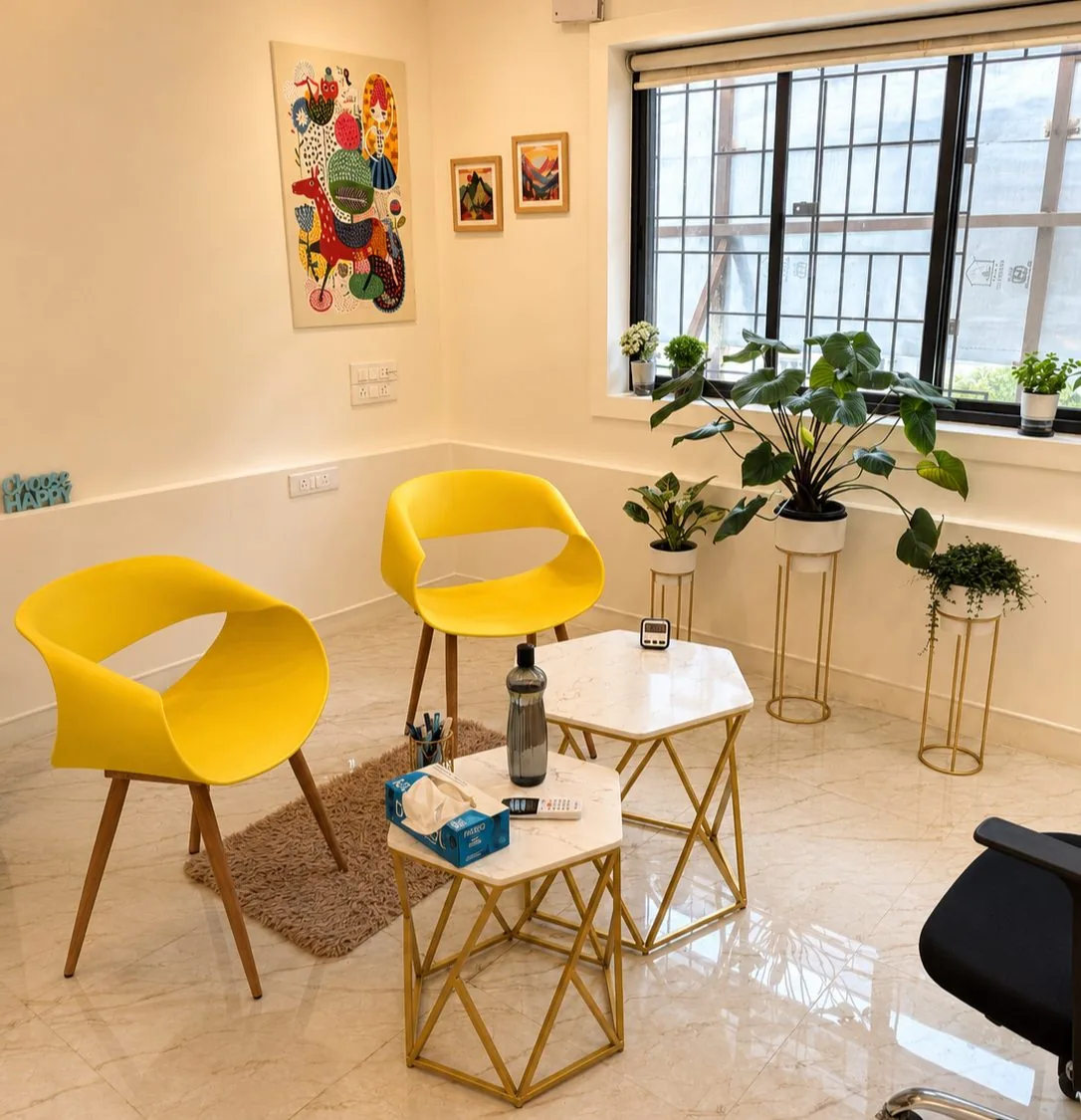
Our clinic provides a private setting for in-person psychological consultations, with online appointments also available where appropriate.
CINQ.IN Polyclinic2nd Floor, Gulshan Appartment,
Baner Road, Near Mauli Garden,
Baner, Pune 411045
Therapy in Pune: What Brings People In
Pune is a fast-moving city, and the pressures people bring to therapy often reflect that.
Work, IT & burnout
Long commutes, tight deadlines and always-on work culture take a toll. Many clients from Hinjewadi, Wakad, Baner and the PCMC belt come to us with burnout, sleep problems, anxiety and the feeling of running on empty.
Student life & academic pressure
Pune is a major education hub. Exam stress, career uncertainty, comparison and the pressure to have everything figured out are common concerns among students and young adults.
Traffic, cost of living & daily stress
Rising costs, crowded commutes and a competitive environment add up. Sometimes the stress isn't one big event — it's the accumulation of ordinary days that never quite slow down.
Lifestyle, FOMO & work-life balance
Social comparison, the pressure to keep up, and the difficulty of switching off are increasingly common. Therapy offers a space to look at these patterns honestly and decide what to change.
Whatever brings you in, you don't need to have it neatly labelled. A first conversation is enough to start.
Colleges & universities near our Baner clinic
Our clinic is within a 15–30 minute commute of several major Pune institutions, which makes it practical for students and young adults to attend sessions between classes or after campus hours.
10–15 minutes: NICMAR University (Balewadi), IISER Pune (Pashan Road), Spicer Adventist University (Aundh), Savitribai Phule Pune University / SPPU (Ganeshkhind).
20–30 minutes: Symbiosis College of Arts & Commerce (SB Road), Fergusson College (Shivajinagar), Brihan Maharashtra College of Commerce / BMCC (Deccan), Modern College (Shivajinagar), MITCON Institute of Management (Balewadi), ISB&M (Nande), Suryadatta Group of Institutes (Bavdhan).
Commute times are approximate and depend on traffic. Online sessions are also available if travelling is difficult.
Therapy, Counselling & Psychologists
The right starting point depends on what you are experiencing and what kind of support you need.
Therapy
The structured process of psychological support or treatment, guided by a trained professional over time.
Counselling
Often used for supportive work around emotional, relationship, adjustment, lifestyle or life concerns.
Psychologist
A trained mental-health professional whose role and qualifications depend on their training and area of practice.
Ready to Take the First Step?
Start with a conversation about what you are experiencing. We can help you find the right psychologist or next step.
Not sure therapy is the right first step?
A free, anonymous self-check takes about 2 minutes and can help you put words to what you're feeling – anxiety, low mood, focus, or something else. Your result comes with clear, honest guidance on what to do next.
Have a question before you book?
Pick what you'd like to understand better — whether you need therapy at all, who to see, what it costs, or what happens in the first session. You'll get a short, honest answer and links to the fuller detail.
Not sure what kind of support you need?
Answer a few quick questions and we'll point you to the kind of support that fits — therapy, counselling, psychiatry or guidance. You can skip at any point.
Frequently Asked Questions About Therapy
Do I need a diagnosis before starting therapy?
No. People seek therapy for many reasons, and you do not need a formal diagnosis to discuss a concern with a psychologist.
How long is a therapy session at CINQ.IN?
Current therapist sessions listed by CINQ.IN are 45 minutes. Session duration can vary for other services, such as psychiatric consultations.
How often should I attend therapy?
Therapy usually happens once a week. It may be more frequent at the start, during a difficult phase, or for approaches that need regular practice — ERP for OCD, for example, can involve 3–4 sessions a week. In the later stages of treatment, sessions are often spaced out to fortnightly or monthly as you become more independent.
How many therapy sessions will I need?
There is no single number that applies to everyone. Duration depends on the nature of the concern, goals, progress and treatment approach.
Is online therapy available?
Yes. CINQ.IN offers online sessions where appropriate, alongside in-person care at the Baner clinic.
How much does therapy cost in Pune?
CINQ.IN currently lists 45-minute therapist sessions ranging from ₹800 to ₹3,500 depending on the clinician and service. Check the booking page for current availability and fees.
How do I choose the right psychologist?
Consider the concern you want help with, the psychologist's experience, approach, format, availability, fee and whether you feel comfortable working with them.
Can therapy help with anxiety or depression?
Psychological therapy is commonly used to support people experiencing anxiety and depression. The appropriate approach depends on the person's circumstances and may sometimes involve psychiatric care as well.
Can therapy help with relationship problems?
Therapy can provide a structured space to explore relationship patterns, communication, conflict and life transitions. The appropriate format depends on the situation.
What happens if I don't feel comfortable with my psychologist?
Therapeutic fit matters. Discussing your concerns with the psychologist can sometimes help; if the fit still does not feel right, another clinician may be more suitable.
Can I change psychologists?
Yes. You can explore another CINQ.IN clinician if you feel a different experience, approach or area of expertise would better suit your needs.
What should I do if I am in immediate danger or having thoughts of harming myself?
Therapy appointments are not emergency services. If you are in immediate danger or at risk of harming yourself or someone else, seek urgent local medical or emergency support.
Does therapy work for everyone?
Therapy helps most people, but outcomes vary with fit, timing and the type of problem. If progress stalls, a good therapist will discuss what's blocking it rather than letting sessions drift.
What's the difference between a psychologist and a psychiatrist?
Psychologists provide therapy and psychological testing and are not medical doctors. Psychiatrists are medical doctors who diagnose and prescribe medication – typically a working diagnosis, since formal diagnosis is the domain of clinical psychologists. Many treatment plans involve both.
How do I find a good therapist in Pune?
Look for a clinician whose training and experience match your concern, who works in a format that suits you (in-person or online), and whose fee and availability fit your situation. Fit matters as much as qualifications – you should feel able to speak openly. At CINQ.IN you can see our psychologists and book a first session, or call us and we'll help you choose.
Do you offer therapy in Hindi or Marathi?
Yes. Sessions at CINQ.IN are available in English, Hindi and Marathi. You can note your language preference when you book, and we'll match you with a clinician who works in that language.
Where is the CINQ.IN clinic located?
Our clinic is on Baner Road, near Mauli Garden, Baner, Pune 411045 – a short ride from Aundh, Balewadi and Pimple Saudagar, and close to the upcoming Baner–Pashan Link Road metro station. Online sessions are also available across India.
Do you offer evening or weekend appointments?
Yes. The clinic is open Tuesday to Sunday, 10:30 am to 9 pm, with the last appointment slot at 8 pm. Evening and weekend slots are kept specifically for working professionals and for clients in other time zones who need to attend online.
How does therapy pricing work in Pune?
Fees in Pune generally reflect a clinician's seniority, qualifications and experience rather than a fixed market rate. At CINQ.IN, individual 45-minute sessions range from ₹800 to ₹3,500 — the lower end for early-career clinicians and the higher end for senior practitioners with advanced training. Couples sessions cost more than individual sessions because they run longer and involve two clients. Psychiatric consultations are listed separately. We'll always confirm the exact fee before you book.
I work in IT / have a demanding schedule. Can you accommodate that?
Yes — a large share of our clients work in Pune's IT and corporate sectors, and scheduling is built around that. We offer evening slots up to 8 pm, weekend appointments including Sundays, and online sessions for those who travel or work late. You don't need to rearrange your workday to get support.
Do you see students and young adults?
Yes. We work with students and young adults dealing with academic pressure, exam stress, career uncertainty, comparison and social anxiety. Our Baner location is a short ride from several major colleges and universities in the city.
How long does therapy take?
Duration depends on the nature and complexity of the concern. As a general guide: lifestyle issues and focused concerns may take 2–3 months (about 10–15 sessions); moderate or severe cases and complex issues such as marital discord, grief, workplace stress or adjustment difficulties may take 3–6 months (about 30 sessions); and more biologically driven, genetic, cognitive or chronic/recurrent issues — OCD, trauma, personality disorders, social anxiety, GAD, chronic depression, addiction or bipolar disorder — may need longer-term treatment. Your psychologist will discuss a realistic timeline after the first two sessions.
What happens in the first few sessions?
The first session is about getting to know you — basic information, the issues you're facing, and some screeners where useful — followed by a discussion of next steps. The second session is usually a case history: a planned clinical interview to understand the fuller picture and any complex factors. Therapy itself begins from session 3, based on what was discussed.
Are discounted packages available?
Yes. Discounted packages are available for clients committing to a course of sessions. Ask us when you book and we'll explain the options.
If you're in crisis or having thoughts of harming yourself: therapy appointments are not emergency services. Please call 112 (India Emergency), go to your nearest hospital, or contact a suicide-prevention helpline right away. Reaching out is a sign of strength.
Clinically reviewed by: the CINQ.IN clinical team ·
Last reviewed: August 2026
Sources: National Institute for Health and Care Excellence (NICE) guidelines for common mental health conditions; Beck, J. S. (2021) Cognitive Behavior Therapy: Basics and Beyond.